The Silent Heist: How China’s APTs Are Stealing the World’s Priceless Secrets
Introduction: The Invisible Thieves
Imagine a competitor didn’t have to spend billions on research and development. Imagine they could simply copy your finished product—your next-generation microchip, your breakthrough medical drug formula, or the blueprints for your cutting-edge jet engine—with the push of a button.
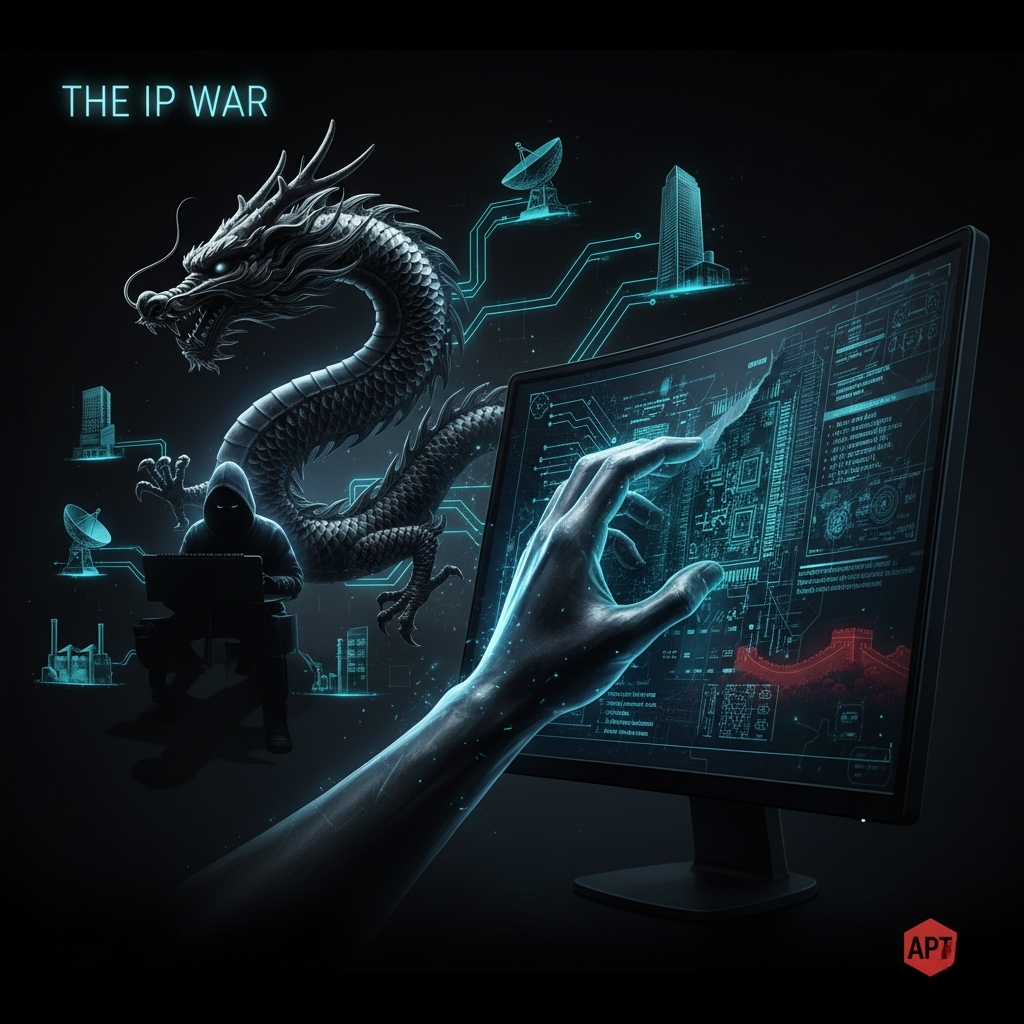
This isn’t science fiction; it’s the reality of state-sponsored economic espionage, and no nation executes it on a scale quite like China. Behind this massive effort are highly skilled and persistent groups of state-linked hackers known as Advanced Persistent Threats (APTs). These aren’t petty criminals; they are digital spies working with military-like precision to steal the world’s most valuable asset: Intellectual Property (IP).
This article will pull back the curtain on these shadow operators, explaining who they are, how they carry out the “silent heist,” and why this slow, steady theft of innovation poses one of the biggest economic challenges of our time.
Who Are the APTs? A Team of Digital Spies
Unlike the ransomware gangs we discussed previously, Chinese APTs are generally not motivated by quick cash. Their goal is strategic, national benefit. They are tasked with filling technological gaps, accelerating China’s military modernization, and boosting its global industrial competitiveness.
These groups are often linked to the People’s Liberation Army (PLA) or the Ministry of State Security (MSS), and they operate under various codenames given by cybersecurity firms:
- APT10 (Stone Panda): Known for large-scale, global campaigns, often targeting IT service providers to gain access to their downstream clients (a classic “supply chain” attack).
- APT41 (Wicked Panda): Unique because it has been observed conducting both state-sponsored espionage and financially motivated cybercrime, often blurring the lines between the two.
- APT3 (Gothic Panda): Frequently targets high-tech industries, defense contractors, and technology companies critical to the US economy.
The Playbook: Patience, Persistence, and Plunder
Chinese APTs follow a disciplined, methodical process that prioritizes long-term, undetected presence over quick, disruptive strikes. Their operations are designed to linger in a network for months or even years.
1. The Initial Foothold: The Soft Target
They rarely attack head-on. Instead, they look for weak entry points:
- Zero-Day Exploits: Using vulnerabilities in software that the vendor doesn’t know about yet.
- Spear Phishing: Highly targeted emails aimed at specific employees (often senior researchers or IT staff) containing malware-laden attachments or links.
- Supply Chain Compromise: Infiltrating a company through a less-secure partner, vendor, or IT service provider.
2. The Slow Crawl: Living Off the Land
Once inside, they don’t make a lot of noise. They often use tools that are already installed on the network—like PowerShell or remote desktop services—a tactic known as “Living Off the Land”. This makes their activities look like normal system administration, allowing them to remain undetected by traditional anti-virus software. They meticulously map the network, identify the servers holding the IP, and patiently wait for the right moment.
3. The Extraction: The Digital Truckload
The ultimate target is often proprietary data like schematics, source code, research documents, or manufacturing processes. When they execute the theft, they compress the files, often encrypt them, and siphon them out slowly over time through various covert communication channels. The goal is always the same: steal the competitive edge.
The Stolen Assets: More Than Just Money
The true cost of this espionage isn’t measured in dollars stolen from a bank account, but in lost time, innovation, and global leadership. What exactly are they taking?
| Sector Targeted | Examples of Stolen IP | Why It Matters |
| Aerospace & Defense | Jet engine schematics, drone technology, radar systems. | Directly accelerates China’s military modernization and capability parity with global powers. |
| Pharmaceuticals | Formulas for new drugs, clinical trial data, vaccine research. | Saves billions in R&D costs and allows for quicker entry into highly profitable global markets. |
| High-Tech & Manufacturing | Semiconductor designs, advanced robotics blueprints, proprietary AI algorithms. | Fuels China’s stated goal of achieving self-sufficiency and dominance in critical technologies. |
The Economic Fallout: A Challenge to Innovation
This systematic theft has profound consequences. It discourages companies from investing in deep research when they know their secrets might be stolen. It gives Chinese state-owned enterprises an unfair advantage, undercutting foreign competition and ultimately impacting jobs and economic growth in the countries where the innovation originated.
Governments, particularly in the US and Europe, have labeled this IP theft a significant national security threat. The response is complex, involving legal actions, sanctions, international cooperation, and a massive push for better corporate cybersecurity.
Conclusion: The Need for Zero Trust
The threat from China’s APTs is continuous, evolving, and strategic. We are in an era of constant, low-level cyber conflict where the battlefield is not a physical border, but the internal networks of research labs and corporate headquarters.
For any organization, the lesson is clear: you must adopt a “Zero Trust” model. Assume that an attacker is already inside your network. Verify every access request, compartmentalize your most sensitive IP, and monitor all network activity for the faintest signs of lateral movement.
In this shadow war, knowledge is power, and protecting your most valuable secrets is the defining challenge of the digital age.
