
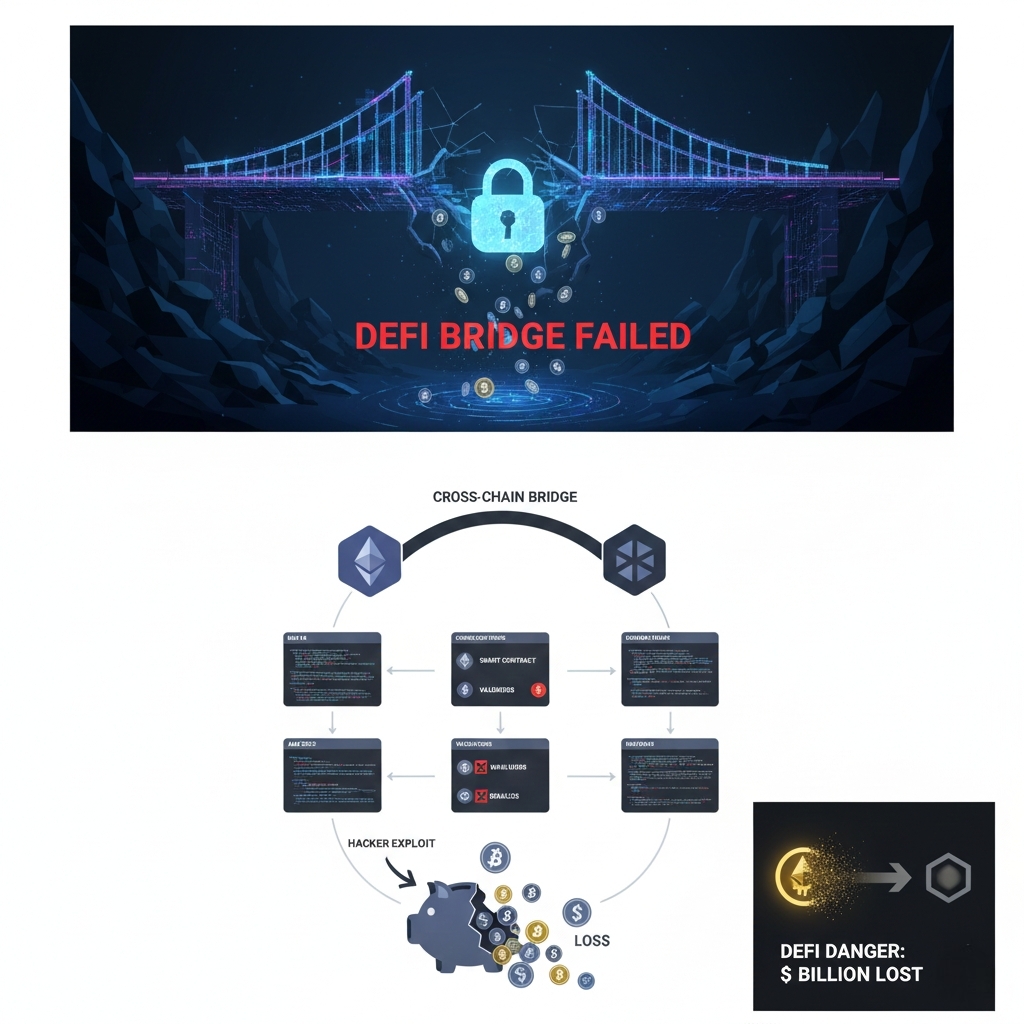
The Broken Bridge: Why DeFi’s Lifelines Are Becoming Hacker Goldmines
Introduction: The Promise and Peril of Connecting Crypto Worlds
Imagine you have two bustling cities, each with its own unique culture, economy, and language. Now imagine wanting to move goods, people, or ideas between them. You’d need a bridge, right? In the world of cryptocurrency, these “cities” are different blockchains—like Ethereum, Binance Smart Chain, Solana, or Polygon—each operating independently. The “bridges” that connect them, allowing assets to move seamlessly from one chain to another, are called DeFi Bridges (Decentralized Finance Bridges).
These bridges are absolute marvels of innovation, essential for the growth and interconnectedness of the entire crypto ecosystem. They unlock liquidity, foster new applications, and promise a truly multi-chain future. However, they’ve also become the juiciest target for hackers, leading to staggering losses. Why? Because the very technology designed to connect these worlds often harbors critical security flaws that sophisticated attackers are exploiting for billions of dollars.
This article will break down what DeFi bridges are, why they’re so vulnerable, and what these gaping security flaws mean for the future of decentralized finance.
What Exactly Are DeFi Bridges, and Why Do We Need Them?
At its core, a DeFi bridge allows you to essentially “transfer” tokens or data from one blockchain to another. But you can’t actually move a token from Ethereum to Polygon like you’d drag a file between folders. Blockchains are independent ledgers.
So, how do bridges work? They typically follow a “lock and mint” or “burn and mint” model:
You lock your asset: When you want to move, say, 100 ETH from Ethereum to Polygon, you send your 100 ETH to a smart contract address on the Ethereum chain, which effectively locks it up.
Validator confirms: A network of “validators” (like gatekeepers) on the bridge confirms that your ETH is indeed locked on Ethereum.
New token is minted: On the Polygon chain, an equivalent “wrapped” version of your ETH (e.g., 100 wETH) is then minted and sent to your Polygon wallet. This wETH is backed 1:1 by the ETH locked on the original chain.
Reverse process: To move back, you “burn” the wETH on Polygon, and the original ETH is unlocked and returned to you on Ethereum.
This process is critical because it breaks down the “silos” of individual blockchains, allowing assets and users to participate in different DeFi ecosystems, access lower fees, or find better yields.
The Achilles’ Heel: Why Bridges Are Such Easy Targets
While ingenious, the complexity of these bridges creates numerous points of failure, making them incredibly attractive targets for hackers. Think of it this way: bridges connect two secure fortresses, but the bridge itself might be weaker than either wall.
Here are the main categories of security flaws:
1. Smart Contract Vulnerabilities: Code Is Law… Until It’s Broken
Bridges rely heavily on smart contracts—self-executing code that lives on the blockchain. If there’s a bug, an oversight, or a logical flaw in this code, hackers can exploit it.
Logic Bugs: The most common culprit. A hacker might find a way to trick the contract into thinking they’ve locked assets on one chain when they haven’t, allowing them to mint new tokens on the other chain without any backing. Or, they might find a way to withdraw more funds than they’re entitled to.
Reentrancy Attacks: While less common in newer designs, these allow an attacker to repeatedly call a function in a smart contract before the first transaction is complete, draining funds.
2. Compromised Validator Networks: The Broken Trust
Many bridges rely on a set of trusted validators or multi-signature (multi-sig) wallets to approve transactions and ensure the “lock and mint” process is legitimate. If these validators are compromised, the entire bridge falls apart.
Centralization Risk: Some bridges have a small number of validators. If a hacker can gain control of a majority of these (e.g., 5 out of 9), they can unilaterally approve fraudulent transactions, effectively draining the locked funds.
Key Compromise: The validators’ private keys (their digital identity) can be stolen through phishing attacks, social engineering, or by exploiting vulnerabilities in their infrastructure. This is precisely what happened in the Ronin Bridge hack, where North Korean-linked hackers gained control of 5 out of 9 validator keys, leading to the theft of over $600 million.
3. Economic Exploits & Oracle Manipulation
While less frequent, some sophisticated attacks involve manipulating the economic incentives or the data feeds (oracles) that a bridge relies on. If an attacker can trick the bridge into believing an asset is worth more or less than it actually is, they might be able to withdraw more than they deposited.
4. Lack of Auditing and Testing
The rush to innovate in DeFi means that some bridges are deployed without sufficient security audits by reputable third parties or rigorous stress testing. These can leave gaping holes that are quickly discovered by malicious actors.
The Staggering Losses: Billions Gone
The statistics are alarming. DeFi bridges have become the single largest target for crypto hackers, often resulting in losses far exceeding individual exchange hacks:
Ronin Bridge (March 2022): Over $600 million in ETH and USDC stolen after hackers compromised validator keys.
Wormhole Bridge (February 2022): Over $320 million stolen due to a smart contract vulnerability that allowed unauthorized minting of tokens.
Harmony Horizon Bridge (June 2022): Approximately $100 million stolen, again through compromised private keys.
These attacks highlight a critical weakness that threatens to undermine confidence in the entire multi-chain vision of Web3.
Conclusion: Building Stronger Foundations for a Connected Future
DeFi bridges are indispensable for the growth of the cryptocurrency ecosystem. However, their very nature—acting as conduits between disparate systems—makes them exceptionally complex and vulnerable. The repeated, multi-million dollar exploits underscore the urgent need for:
Robust Security Audits: Before deployment, smart contracts must undergo thorough, independent security reviews.
Decentralization: Spreading validator control among many independent entities makes it harder for a single point of failure to bring down the bridge.
Advanced Cryptography: Exploring new cryptographic techniques, like zero-knowledge proofs, that could reduce reliance on trusted validators.
Bug Bounties: Incentivizing white-hat hackers to find and report vulnerabilities before malicious actors do.
Until these security flaws are systematically addressed, DeFi bridges will remain both the vibrant highways of the crypto world and its most tempting target for digital plunderers. The future of decentralized finance depends on us learning to build these critical connections stronger, safer, and more resilient against the ever-present threat of the “broken bridge
