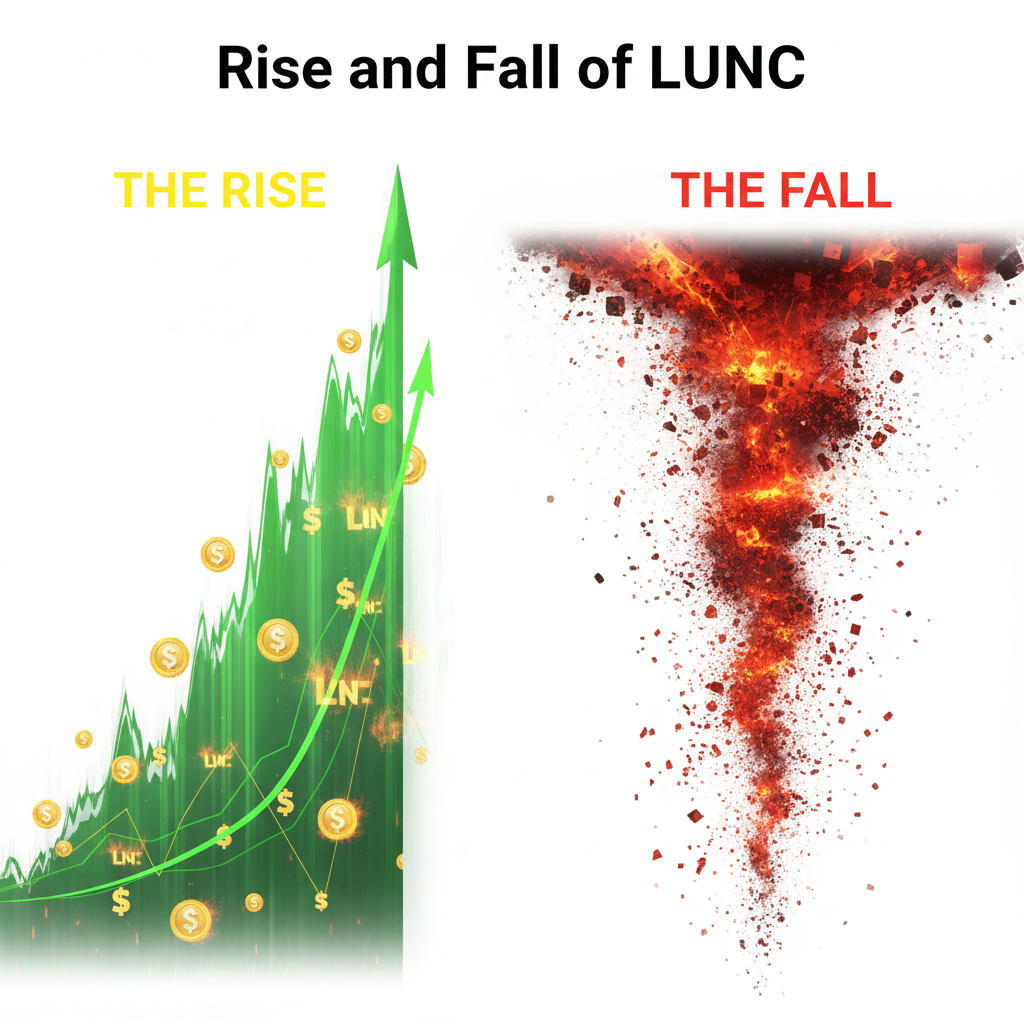
The Rise and Fall of Terra Classic (LUNC): A Defining Moment in Crypto History
In the brief yet turbulent history of cryptocurrencies, few events have shaken the financial world quite like the collapse of the Terra ecosystem in May 2022. This is not merely a story of a coin’s price dropping, but a saga involving billions of dollars vanishing into thin air, investors facing financial ruin, and the spectacular downfall of a project that was once a shining star in the crypto universe.
What we now know as Terra Classic (LUNC) was formerly LUNA, a titan ranked among the top 10 global cryptocurrencies. Let’s delve into its dramatic rise and cataclysmic fall.
The Rise: Ambitions and Algorithms
The Terra project was co-founded by South Korean entrepreneurs Do Kwon and Daniel Shin. Their vision was to create a stable digital currency that could be easily used in real-world transactions, offering a decentralized alternative to traditional finance.
The success of the Terra ecosystem hinged on the intricate relationship between its two primary tokens:
- TerraUSD (UST): A “stablecoin” designed to maintain a value pegged exactly to $1.00 USD.
- LUNA (now LUNC): The native network token used to absorb price volatility and keep UST’s peg stable.
The Catalyst: Anchor Protocol The primary driver behind LUNA’s meteoric price rise was the Anchor Protocol. This was a savings platform built on the Terra network that offered an extraordinarily high yield of nearly 20% APY (Annual Percentage Yield) on deposited UST.
This rate was vastly superior to anything offered by traditional banks. Consequently, investors worldwide flocked to convert their money into UST to deposit into Anchor. As demand for UST surged, the protocol burned LUNA to mint more UST, driving the price of LUNA through the roof. By early 2022, LUNA traded well over $100 and was hailed as a major blue-chip crypto asset.
The Flaw in the System: An Algorithmic Gamble Unlike stablecoins like USDC or USDT, which are backed by actual dollars or liquid assets in a bank, UST was an “algorithmic stablecoin.” Its $1 peg relied solely on computer code and market confidence.
The mechanism worked like a seesaw: If UST’s price rose above $1, the system would burn LUNA to mint more UST. If UST fell below $1, the system would burn UST and mint more LUNA to reduce UST supply and push its price back up.
It was a delicate balance that could only function as long as there was unwavering trust in the system and LUNA maintained significant value.
The Fall: The Death Spiral
In May 2022, the fears of many skeptics materialized. Amidst a broader crypto market downturn, a massive sell-off of UST occurred. The immense selling pressure broke the peg, causing UST’s value to fall below $1.00.
Panic spread like wildfire. Investors rushed to exit their UST positions. The algorithm tried to compensate by doing exactly what it was programmed to do: it started burning the excess UST and minting new LUNA at a furious pace to absorb the shock.
The result was catastrophic. The market was flooded with an exponentially increasing supply of LUNA, crashing its price. In a matter of days, LUNA plummeted from over $80 to fractions of a single cent.
This became known as the “Death Spiral.” UST never regained its $1 peg, and LUNA’s circulating supply ballooned from millions to trillions, rendering the token practically worthless. An estimated $60 billion in market value was wiped out almost overnight.
The Aftermath and the Birth of LUNC
Following the devastation, the Terra community fractured. Do Kwon proposed a “fork” to create a new blockchain, leaving the old, collapsed chain behind.
- The original, collapsed chain was rebranded as Terra Classic, and its token became LUNC (Luna Classic).
- The new chain took the name Terra, with its token called LUNA (LUNA 2.0).
Do Kwon faced various legal charges, including fraud, and after months on the run, he was arrested in Montenegro.
LUNC Today: A Community’s Hope
Today, Terra Classic (LUNC) exists primarily as a community-driven project, viewed by many as a “meme coin” or a highly speculative asset. Its future is now in the hands of a fragmented community attempting to revive it.
The community’s main focus has been implementing “token burn” mechanisms to reduce the hyper-inflated supply of trillions of LUNC tokens, hoping to eventually restore some value. However, given the scale of the collapse, most experts view any significant recovery as extremely improbable.
Conclusion
The rise and fall of Terra Classic (LUNC) serves as a stark cautionary tale for the crypto industry. It demonstrated that financial innovation without solid foundations—built on unsustainable promises like a guaranteed 20% yield—can collapse like a house of cards. The story of LUNC remains a defining chapter in financial history, illustrating the potent mix of ambition, algorithmic risk, and the brutal reality of market forces.
